Walk up a marble double staircase, step off onto the second floor and follow the faint scent of perfume to the fragrance counter. You may be tempted to shop but, our apologies, your credit card is no good here.
The display filled with handpainted perfume bottles is just the first stop in Flagler Museum’s newest exhibit, “May I Help You, Madame? The Making of the Modern Department Store,” which is on view through May 24 in Palm Beach.
As the holiday shopping season heads into its final chaotic stretch, the exhibit reminds us of how society’s love affair with department stores began. Visitors can step back in time to when these stores emerged, becoming not only places to shop but also “theaters of modern life,” as Campbell Mobley, the museum’s chief curator, calls them.
Along the walls of the exhibit space are historic advertisements and architectural renderings, fashion displays and cases featuring shoes, hand fans, hats, hatboxes and hatpins, beaded purses and gloves — along with original store ephemera that give a glamorous glimpse into an era that became the blueprint for modern consumerism.
What’s the connection between the museum and the department store?
For starters, it’s less than a mile away from Worth Avenue, the world-renowned luxury shopping destination, in the heart of the affluent barrier island.
Also, the mansion known as Whitehall, which was the winter retreat of American industrialist Henry Flagler and his wife Mary Lily, was built during the Gilded Age around the same time the department store concept was revolutionizing retail in Paris.
And thanks to letters from the museum’s extensive archives, we know the Flaglers liked to shop till they dropped at Lord & Taylor near their home in New York City — “a reminder that no one, however grand, was immune to the allure of display and abundance,” according to the exhibit’s welcome message.

A kismet moment
Mobley and Amanda Skier, the museum’s executive director and CEO, were set on a department store-themed fall exhibition inspired by the innovation of Le Bon Marché in 19th-century Paris and themes in Émile Zola’s novel “Au Bonheur des Dames.”
But a chance encounter in Palm Beach one afternoon turned their idea into “one of those kismet moments,” Mobley said.
While having lunch, Skier casually mentioned their upcoming project to a man who turned out to be Palm Beacher Simon Doonan, the author, fashion commentator and former creative director of Barneys New York.

He’s famously known as the designer of Barneys New York’s eye-catching holiday window displays, dressing them with life-sized caricatures of icons of music, movies, television, fashion and pop culture, among others, from the mid-1980s until 2019.
“So [Amanda] introduced him to me and we immediately started talking about the rise of the department store,” Mobley said.
They bonded over their appreciation of Zola’s book and quickly found “they were finishing each other’s sentences,” she said. “While Simon is so talented and such a creative, he is brilliant.
“He awoke something in us here in the curatorial department to be as creative as possible and to think about the design of this show. It’s very different than shows that we have had in the past. It’s very focused on the design, because when you go to these department stores, it’s all about the displays that they have done. It’s not just the windows, so that’s what we were able to play with.”

Let’s go shopping
With the goal to build an exhibit around a complete department store experience, they decided to incorporate the senses — something they’ve never done before. Think a colorful silk scarf designed by Liberty of London in 1949 for Flagler’s granddaughter, Jean Flagler Matthews, draped over a ribbon-lined box, with piano and organ music that would have been played live in-store coming from the speakers and a scent machine releasing a waft of perfume near the fragrance counter.
“Like Simon says, when it comes to the windows themselves, or even the way we’ve thought about the design of this show, it’s almost a treat for the guests,” Mobley said. “It’s about that experience from those little luxuries in life.”
Once visitors learn about the history of the Parisian department store, it’s time to head back to the United States where modern Americanized versions were popping up in big cities: Wanamaker’s in Philadelphia, Marshall Field’s in Chicago and Saks Fifth Avenue in New York City.

Peruse the pages of a mail-order catalog and learn about other technological advances that helped department stores serve their customers, including the paper bag, telephone, electric light, elevators, escalators and the typewriter.
Take a moment to pay homage to the backbone of the department store — the shopgirl — who stood steadfast behind the counter as “part employee, part performer and all modern woman,” according to the exhibit.
There’s also a spot devoted to the role of women as consumers for whom shopping became “both leisure and liberation.”
The fashion focal point
No department store exhibit would be complete without an actual window display, and Doonan was happy to lend his legendary talents to the effort, Mobley said.
“It’s a feast for the eyes,” she said. “This was such a wonderful experience to build upon with Simon alongside my curatorial staff,” including archivist Paige Cochran and research librarian Victoria Lemell.
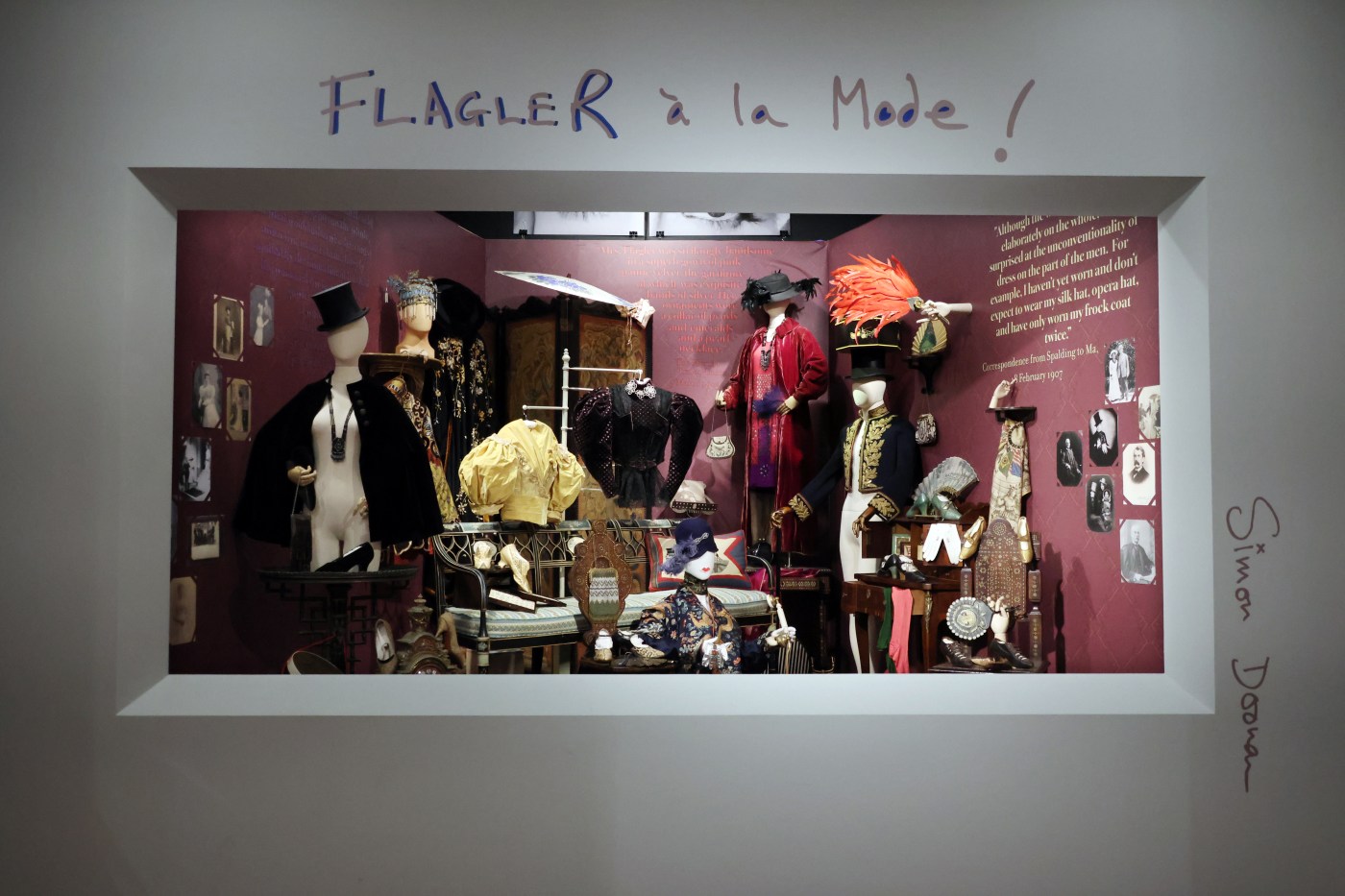
Making their choices through “Simon-colored lenses,” Mobley said, they pulled pieces from the permanent collection to create “Flagler A LA MODE,” a mélange of clothing and accessories from the 18th to mid-20th centuries that are too fragile to display year-round. Then Doonan sprinkled in the “touches of surrealism and eccentricity” that he’s known for.
Some of the items belonged to the Flagler family and its descendants, such as Mary Lily and Matthews, while others came from the museum being “a repository for some donations by great Palm Beachers,” Mobley said.
Among them, Iris Apfel, the interior and fashion designer known for her flamboyant style and signature oversized glasses who died in Palm Beach in March 2024 at age 102. Her vintage moiré purse, adorned with steel sequins and metallic threads, is dangled by a mannequin in the back of the display.

“No detail went unnoticed,” Mobley said. “Even the wallpaper that we made specifically for this is the ‘F’ that’s above the fireplace that we then made into this kind of caning pattern.”
Here’s a tip: Scan the QR code on the wall to learn more about key pieces in the window display.
Simon and a Sharpie
The day before opening the exhibit to the public, Mobley asked Doonan to come “zhuzh some things up.” Wielding a Sharpie marker, he put his own finishing touches on the collaboration, drawing frames around vintage B. Altman & Co. ads, writing “J’adore le shopping” on the mirror of a vanity desk piled high with hatboxes, and scrawling fashionable quotes from the famous on shoe boxes. (“Time wounds all heels!” from Dorothy Parker, for example.)
What does the future have in store?
Despite the growth of e-commerce and the closure of some major stores in recent years, Mobley said people still want to have that luxury experience.

“I think people do like to touch the fabrics,” she said. “Yes, we’re doing so much online shopping and that sort of thing, but I think there’s something really special about going in, feeling the fabrics, really seeing these pieces and trying things on. And it connects us, to go shopping with other people.”
Tales from another window dresser
The Urban Electric Co. will premiere its behind-the-scenes documentary, “Street Theater,” with a lecture at 6 p.m. Jan. 7 at the museum. The film follows design editor Robert Rufino, who formerly directed visual merchandising at Henri Bendel and Tiffany & Co., as he creates window installations for The Current on 10th Street in New York City. A cocktail reception is set for 5:30 p.m. Tickets are $50 for nonmembers, $30 for members below patron level and their guests, and free for patron level members and above. Visit flaglermuseum.org.
IF YOU GO
WHAT: “May I Help You, Madame? The Making of the Modern Department Store”
WHEN: Through May 24
WHERE: Flagler Museum, 1 Whitehall Way, Palm Beach
COST: Museum admission is $28 for guests age 13 and older, $14 for children ages 6-12, and free for those age 5 and younger.
DON’T MISS: The Flagler Museum Café offers a seasonal assortment of gourmet sandwiches and Gilded Age-style Tea Service (select days). Holiday Evening Tours are available Dec. 18-23. Extra fees apply.
INFORMATION: flaglermuseum.org

Leave a Reply