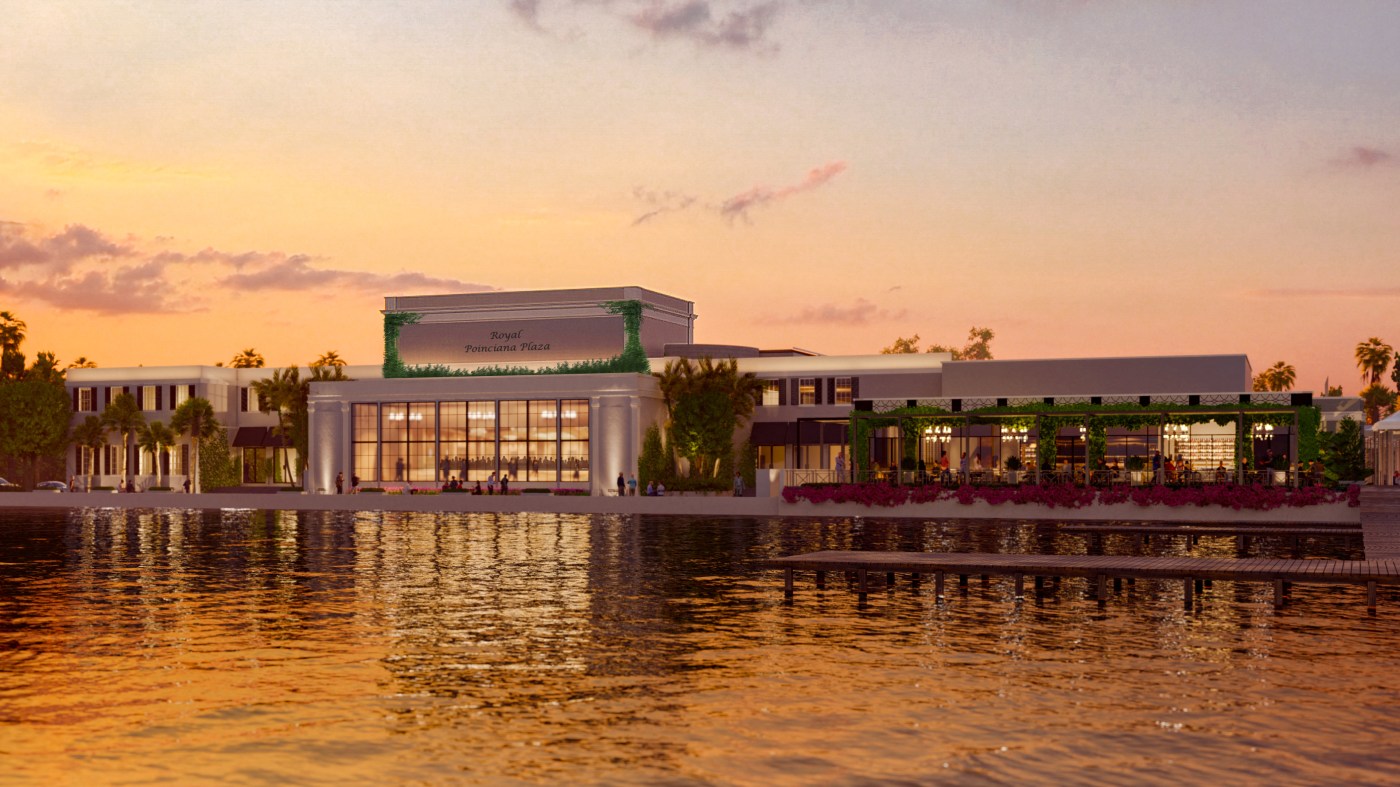
The historic Royal Poinciana Playhouse — a onetime Palm Beach cultural nexus that’s lain dormant for the past two decades — is being reincarnated in a grand style befitting the island’s cachet.
A phased opening began this fall for the new Glazer Hall, a $30 million-plus revitalization of the Regency-styled theater where the first full-length American classical ballet, “The Princess,” premiered during its inaugural 1958 season — and no less than the grand dame of the stage, Helen Hayes, starred in revivals of “The Cherry Orchard” and “The Glass Menagerie” in the early 1960s. New programming is scheduled to kick into high gear in January with “The Amazing Acrobats of Shanghai Circus” on Jan. 22, singer Corinne Bailey Rae on Jan. 23 and “An Evening with James Patterson & Mike Lupica,” on Jan. 25, with a wide variety of acts in the weeks to follow, https://glazerhall.org/#events.
“The great thing about this venue is that it’s going to be everything for everyone,” says Allison Stockel, who’s served as the center’s executive director since April. She compares the variety of the programming to that of Ridgefield Playhouse in Connecticut, which she previously operated.
“One weekend was like a microcosm of what the entire season looked like,” Stockel says. “You know, there was a dance program next to a comedy, next to family, next to rock, next to pop or jazz or opera. And that’s what we’re going to do here.”
Stockel adds that sponsors will also be doing some special cocktail parties and dinners for members, alluding to Glazer Hall’s multipurpose dynamic as a non-profit theater, cultural center and event space.
“All sorts of things are going to be happening,” she says.

Glazer Hall co-founders and co-chairs Jill and Avie Glazer.
Photo courtesy of Glazer Hall
The revitalization of the once-illustrious facility began about five years ago. Originally called The INNOVATE, the name was changed to Glazer Hall in honor of co-founders and co-chairs Jill and Avie Glazer, longtime Palm Beach residents whose vision, dedication and a financial commitment of more than $15 million have been central to the project.
“The Royal Poinciana Playhouse has languished in the dark for far too long. We felt it was time to turn on the lights and bring this jewel box back to life,” says Avie Glazer, who owns the Tampa Bay Buccaneers and with his wife shares a passion for philanthropy.
“It was the board that said, you know, with just the amount of sweat equity, you guys deserve this,” Stockel says in explaining the name change for Palm Beach’s first new nonprofit arts organization in more than 60 years.
What emerged from the Glazers’ vision and equity is a 27,000-square-foot performing arts center that retains the exterior appearance of the Royal Poinciana Playhouse as well as some interior architectural details, such as architect John Volk’s historic staircase and certain color schemes.
“And so it has the same feel,” Stockel says. “You don’t walk in thinking that you’re in a different space. You walk in thinking, ‘Wow, this looks similar to what I remember it to be.’”
However, that is largely where the similarity ends.
“From the outside, it looks exactly the same, but it’s a different theater,” Stockel says. “It used to be, you’d walk into a very small lobby. And there was no water view. Now the lobby is front to back. You walk in and you see the water at the other end. There’s also a water-view terrace. Prior to a show, members can go out and have cocktails out there.”
Water is also the focus of perhaps the most distinctive feature of the renovation — instead of a traditional backdrop, the scene behind the theater’s stage can be a live view of the Intracoastal Waterway.
“Now you can do something where if you have a solo artist who doesn’t want a lit-up screen behind them, they can have the view of the water and the sunset,” Stockel says. “And because it’s a multipurpose space, when you have parties and private events, well, it’s just the most gorgeous view.”
There is a 1,200-square-foot, second-floor space for those events in addition to the option to reconfigure the theater’s seating, which has been halved from the original capacity of 800 to now 400 seats.
“So that’s very different as well,” Stockel says. “But it’s going to have really everything — state-of-the-art equipment for lighting and sound and movies. And the bathrooms are twice the size of what they used to be.”
Does the center’s director expect that the limited capacity will lessen the venue’s own “star power,” so to speak?
“No, while the seating may be less, it’s going to have big names, because, look, a performer is going to get what a performer is going to get. Right? It’s whatever they cost. I ran a 500-seat theater and we would get Willie Nelson and Kristen Chenoweth and Squeeze and Blondie and major names that would perform in theaters four times our size.
“So the difference is that your tickets are going to be a little higher, right? Because if an artist costs, you know, $100,000, and then you have your expenses, divide that by the seats, and that’s your ticket price. I mean, it’s simple math.”
But, Stockel points out, there’s a payoff for the audience. “What you get as a patron is the ability to see these amazing names, these really world-renowned performers in a tiny, intimate venue. It feels like you’re seeing them in your living room. I think that was the allure of the venue that I used to run and that’s going to really be the allure of this.”

A projected rendering of a Glazer Hall event.
Photo by Brian Graybill
Show starters
Programming at Glazer Hall is scheduled to kick into high gear in January 2026, with a wide variety of acts to follow, https://glazerhall.org/#events.
Leave a Reply