On a November day in 1970, at a momentous time in the most consequential year of his life, one of the most famous people in the world was sitting alone on a blanket by the ocean south of the pier in Deerfield Beach, as far away from the pressure of being George Harrison as he could get.
The Beatles guitarist and songwriter had just days before put the finishing touches on his solo album, “All Things Must Pass,” a deeply personal statement that would forever change critical perceptions of Harrison as an artist. As he sat on the beach, the album was mere weeks away from being revealed to the public on Nov. 27.
At the same time, the album’s release would be tangible evidence, if the world still needed it, that the long and winding road of the Beatles’ fractious breakup was coming to an end. Paul McCartney would file a lawsuit to dissolve the partnership the following month.
The rumor of Harrison’s presence over the course of some 10 days in Deerfield Beach — closely guarded by locals, some who admit to never having actually seen him — sounds so unlikely, so fantastical, that it’s fair to wonder if it actually happened. George Harrison in Deerfield Beach? Seriously?
Longtime resident Jeff Fisk, a Beatles fan from an early age who bought the 45 of Harrison’s single “My Sweet Lord” on the day it was released, was a fifth-grader when the chatter hit the playground at St. Ambrose Catholic School in January 1971.
The story he heard, which had spread through the local surfing community, was too good to be true: Harrison was at the beach when he was recognized by a surfer chasing after his board and, upon questioning, admitted his identity. The surfer, a respected figure on the waves in Deerfield Beach, was named Paul McCartney.
“You hear a story like that in fifth grade, it’s gotta be true. I told that story for 50 years,” Fisk says with a laugh.
When the COVID-19 shutdown took hold in 2020, Fisk was on the board at the Deerfield Beach Historical Society and, as the unofficial town historian, decided to use his spare time to sleuth out the origins of the Harrison story and separate fact from fiction, including the report that surfer Paul McCartney would later tell him someone had made up.
“I was gonna prove this story or disprove it. I wanted to get some hard facts, and if I didn’t get any, then it was just a tall tale. It became a quest of mine,” says Fisk, 65.
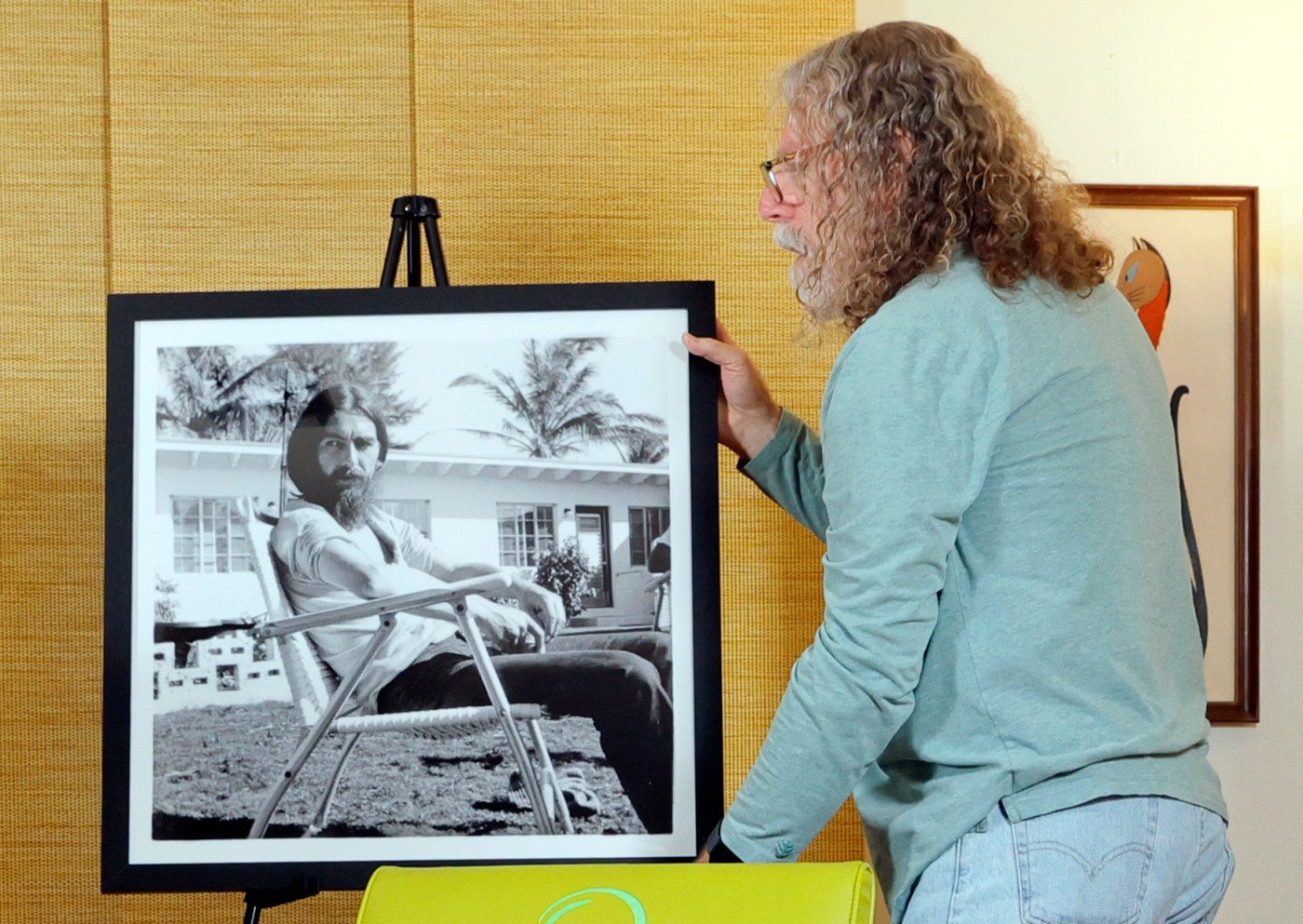
The ensuing years of detective work, internet mining and face-to-face interviews, completed with an assist from local photographer Tom Craig, took a sharp turn in 2024 with a crucial discovery: 18 never-before-seen photographs of Harrison at a Deerfield Beach apartment building owned by his maternal uncle and aunt, Edmund and Mimi French.
The photos are the centerpiece of the Deerfield Beach Historical Society exhibit, “George Was Here: The Best Kept Secret in Deerfield Beach,” coming to the Johnny L. Tigner Community Center on Nov. 7-8. Fisk and Craig will be on hand to discuss their quest, and on Nov. 7 a video archivist will record first-person Harrison memories from anyone who wants to share them.

Don’t ask, don’t tell
Why Harrison decided to come to Deerfield Beach was hard to pin down, but Fisk points out that his mother had died that summer and Harrison spent most of his time in the city with her youngest brother and other family members.
Citing news and publicity photos taken at the time, Fisk believes Harrison came to South Florida shortly after delivering the final master recordings of “All Things Must Pass” on Oct. 30, spending 10 days to two weeks in Deerfield Beach between Nov. 2 and Nov. 21.
Accompanied by wife Pattie Boyd and Beatles road manager Mal Evans, Harrison stayed at the Shore Road Inn, a small hotel around the corner from his family’s property and about a block from the beach. Edmund and Mimi Frenches’ one-story, L-shaped apartment building, at 4020 SE Fifth St., has since been torn down, but the nearby hotel is still in business and, after a recent renovation, is now known as Pier Walk, at 460 S. Ocean Drive.
As the reluctant rock star’s visit became news around town, Fisk says, locals began to fear that too much publicity might spook Harrison and cause him to leave, possibly forever. So they set about creating a cocoon for the so-called “quiet Beatle”: Parents sat young Beatles fans down to deliver an ultimatum — leave Harrison alone, don’t ask him anything, and don’t tell anyone he’s here.
Tom Craig says that during his research, people he knew revealed that they were still keeping the secret more than 50 years later.
“I was born and raised in Deerfield and I’ve known about this since 1971. But it was always just a story. I never really knew anybody who said they had seen him or anything,” Craig says.

Bob Fleury was a regular on the waves in Deerfield Beach while at Pompano Beach High School. He had to give it up after being wounded in Vietnam, but on his return he still spent almost every day at the beach with surfer friends. One afternoon after classes at Palm Beach Community College, he arrived at the section of Deerfield Beach sand overseen by his buddy, charismatic lifeguard Sonny Utt, and noticed a police patrol car parked behind the lifeguard stand.
Fleury inquired and Utt gestured to a long-haired figure who had risen from his blanket and was walking to the waterline.
“He goes, ‘That’s George Harrison of the Beatles. That’s why the police are up here. Sort of protecting him, I guess,’” Fleury recalls.
Fleury and Utt kept their distance and never spoke to Harrison.
“The surfers knew that he was in town, but the guys I hung out with were never, like, ‘Wow George is in town!’ The guy was sitting on a blanket by himself, and we figured he just wanted his privacy. It was all about affording him his privacy,” says Fleury, 77, who now lives in Indian Harbour Beach.
Fisk and Craig came across a newspaper article from the Fort Lauderdale News and Sun-Sentinel, published on Nov. 21, 1970, in which student Ruben Betancourt, entertainment editor for Broward Community College’s newspaper, described a two-day hunt for Harrison, finding him on the beach.
Harrison acknowledged being worried that his location might be discovered, telling Betancourt: “I am not famous anymore. I am not Beatle George anymore. If I wanted to hear screaming, I would play Shea Stadium. But I don’t. I am George Harrison, a musician. That’s all.”
Three days later, Harrison and Boyd were gone, photographed introducing the band Badfinger at a concert in New York.
Pictures imperfect
Craig believes the emotional weight of fame, the loss of his mother, the breakup of the Beatles and striking out on his own with a solo album is evident in the 18 photos featured in “George Was Here.”
“He’s wearing his heart on his face. You can see what he’s been through. You can tell it’s been a hell of a year,” Craig says. “We believe, from our research, that this period that he spent in Deerfield Beach was the only time that year that he had any downtime. He came to a place where he could pretty much just blend into the background and reflect and reinvigorate. And as far as we know, he never came back.”
The discovery of the 18 Harrison pictures began with another newspaper clipping, a 1990 story by Sun Sentinel columnist Gary Stein, whose piece on exorbitant ticket prices for a Paul McCartney concert included quotes from “probably the biggest Beatles fan in South Florida,” Pompano Beach resident Lynn Radigan.
As evidence of Radigan’s Beatlemania, Stein noted that she had once met Harrison while he visited an aunt in Deerfield Beach in 1970, taking with her a folding chair that he sat in and the butt of a Winston cigarette that he smoked.
Fisk and Craig quickly navigated their way to Radigan, who recounted her bold introduction to Harrison — the then-teenager knocked on the door at the Frenches’ apartment, telling the woman who answered that she wanted to speak to Harrison. The woman was Boyd, who brought Harrison to the door, which led to a three-hour conversation between rock star and fan in the front yard of the apartment building.
In telling the story, Radigan casually mentioned to her visitors that when her father came to pick her up, he pulled out a camera. Would they like to see the pictures?
‘The goal that Jeff and I had was to learn more about this story that we always knew about. Without these photos, it’s a nice story. But that’s about all it is.’ — Tom Craig
Kept in a closet in a common photo album, the pictures were taken with an everyday 126 Instamatic camera, printed as 4-by-4-inch, black-and-white images with the standard white border. They are unremarkable, except that they contain an evocative gaze of George Harrison.
With decades of photojournalism work, Craig knew he was looking at a game-changer for the Harrison project.
“The goal that Jeff and I had was to learn more about this story that we always knew about. Without these photos, it’s a nice story. But that’s about all it is. This brings it to a completely different level,” Craig says.
Most of the pictures show Harrison alone, though Radigan is in two scenes, her little sister in another. Harrison is seated in a typical folding lawn chair, in jeans and a long-sleeve T-shirt, barefoot with his hair pulled back in a ponytail. In some, he is holding a cigarette or a drink.
During their second interview at Radigan’s apartment, Craig fed the photos into a high-resolution scanner. On display in “George Was Here,” those pictures have been printed as 24-by-24-inch images.
“They look great. I scanned them at a very high resolution, and I had to do almost nothing to them, except for [eliminating] dust spots,” Craig says. “They’re bordered, black-and-white prints, and I left the original border. Some of them are not quite square on the paper, but I left them exactly how they were printed. They’re historical documents.”
IF YOU GO
WHAT: “George Was Here: The Best Kept Secret in Deerfield Beach” photo exhibit
WHEN: 6-9 p.m. Friday, Nov. 7, and 1-8 p.m. Saturday, Nov. 8
WHERE: Johnny L. Tigner Community Center, 435 SW Second St., Deerfield Beach
COST: Free
LECTURE: A companion lecture by Jeff Fisk will take place at 7 p.m. Nov. 19 at The Old School House, 323 NE Second St., Deerfield Beach. Admission is free.
INFORMATION: Facebook.com/deerfieldhistoricalsociety
Staff writer Ben Crandell can be reached at bcrandell@sunsentinel.com. Follow on IG: @BenCrandell.
Leave a Reply